
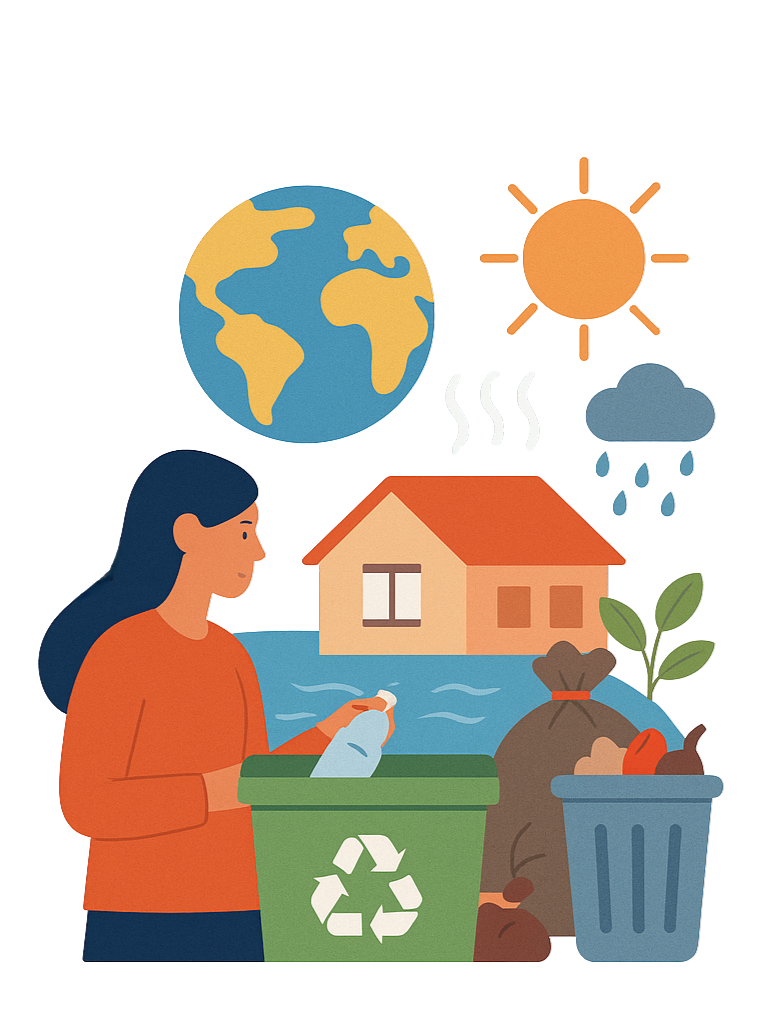
During my Lazord Fellowship, I had the opportunity to explore something I’ve always found both frustrating and fascinating: the way we deal with our household waste. Not in theory, but in real life. In the Bassman district of Amman—one of the most densely populated and diverse areas in the city—I got to see how simple behaviors at home can ripple outward and contribute to something as large-scale as climate change.
So I decided to dig deeper.
Let me walk you through what I found.
Bassman is home to over 400,000 people from all kinds of backgrounds—Jordanians, Syrians, Palestinians, Iraqis. With that diversity comes a wide range of habits, resources, and priorities when it comes to waste. Through surveys and interviews with 368 households, and conversations with people working in solid waste management, I tried to understand: why do people throw waste the way they do? What makes someone recycle—or not? And how does that affect the environment around us?
It turns out, a lot of it comes down to space, time, education, and money.
One insight really stuck with me:
Many low-income families were already practicing the “5 R’s” (Refuse, Reduce, Reuse, Repurpose, Recycle) long before they were buzzwords. But not out of environmental awareness—out of necessity. When you don’t have the option to replace something easily, you fix it. When you can’t afford waste, you minimize it. Ironically, those with fewer resources were often the most climate-resilient in behavior.
On the flip side, many higher-income families were producing more waste and sorting less—even though they had more space, time, and access to resources.
It made me question some assumptions I had.
Gender also played a bigger role than I expected.
In most households, waste sorting was seen as the woman’s job. But after talking to a gender expert, I realized this framing is part of the problem. If we want sustainable behavior to stick, it has to be seen as a shared family responsibility—something men and children are equally part of, not something added to the existing burden on women.
That shift in perspective matters.
Awareness is the real game-changer.
One statistic that hit me hard: 63.5% of participants never sort their waste for recycling purposes, and nearly 79% simply throw their waste in containers without any type of sorting. That’s not just a behavior gap—it’s an awareness gap. And it’s a reminder that real change doesn’t happen from policy alone. It starts at the level of what people believe is worth doing.
And beliefs can change.
So what now?
If there’s one thing I took away from this experience, it’s that community-centered solutions matter most. Awareness campaigns, better infrastructure, local recycling markets, and including waste education in school curriculums—they’re not just checkboxes. They’re levers for change. And if we get them right, we can reduce emissions, protect water, and help communities feel proud of the role they play in climate action.
This research might’ve been local, but the message is global:
Change starts in the home. And homes change when people are empowered to act.
Thanks for reading,